A forthcoming book by Alex Graybar

Being
Human

Why does the most successful species on Earth feel so lost?

For three hundred thousand years we lived in small bands, under open sky, knowing every face around us. Then — in a blink of evolutionary time — we built a world of screens, strangers, and endless choice, and quietly began to ache. Being Human asks one unsettling question: what if nothing is wrong with you, and everything is just out of step with the animal you still are?

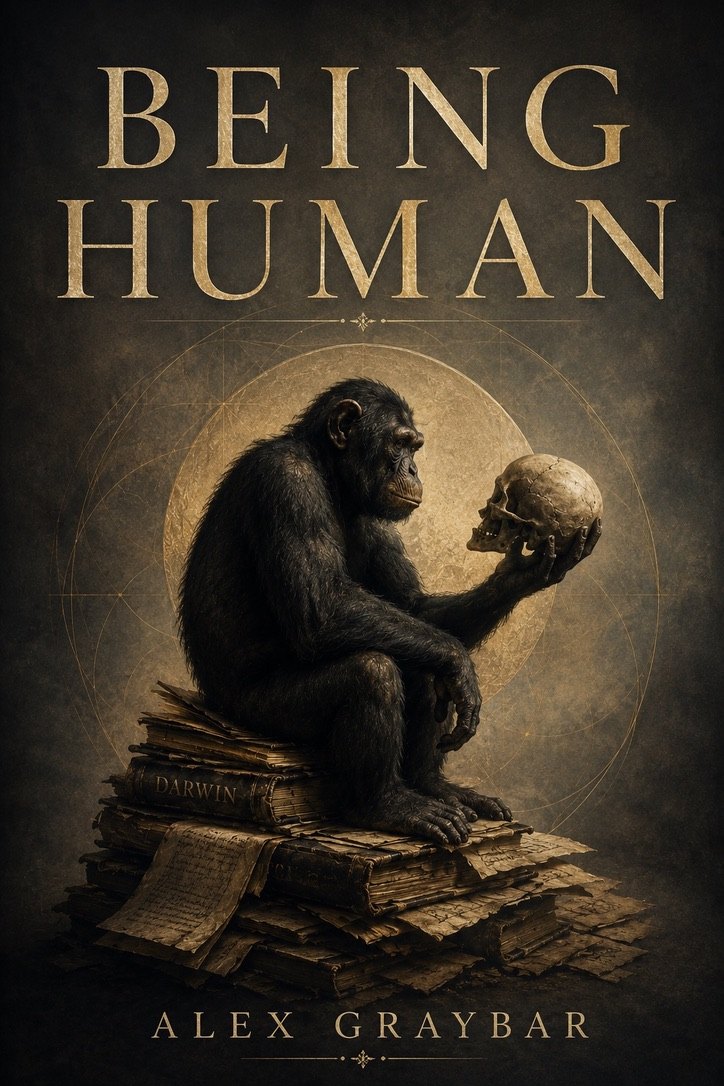
Being Human by Alex Graybar — a chimpanzee seated in thought, holding a human skull atop a pile of ancient books
Scroll
The Premise

We did not evolve for the world we built.

The real problem of humanity is that we have Paleolithic emotions, medieval institutions, and god-like technology. — E. O. Wilson, on the human predicament

For three hundred thousand years we lived as small bands — sharing food, reading faces, sleeping under sky, moving with the seasons. That world wrote our nervous system. It is the body we still inhabit.

Then, in a geological eyeblink, we paved over it. We traded the band for the crowd, the forest for the feed, the shared meal for the screen. The result is not moral failure but mismatch — an animal living in conditions it was never designed to survive, and calling the resulting ache "modern life."

The book's central idea is disarmingly simple: beneath every difference of belief, border, or tribe, we are still one improbable species — animals sharing a single fragile home. Learn to truly feel that, and almost everything starts to shift. Being Human is the case for why, and a map for the way back.

99.9%Genetically identicalThe portion of DNA you share with every other human alive. Difference is shallow. Kinship runs all the way down.
300kYears as foragersThe vast majority of human existence — cooperative, mobile, embedded in nature. The "normal" we forgot.
~12kYears since farmingRoughly 500 generations to remake the outer world, and almost none to remake the inner animal.
A 90-second mirror

How much of a human animal are you?

Your body still runs on instructions written over hundreds of thousands of years — to move, to roam, to belong, to rest, to wonder. Modern life quietly feeds some of those instincts and starves others. Answer honestly and see which parts of your wild self are thriving — and which are running on empty.

Eight quick questions. No email, no wrong answers — just an honest look at the gap between the life you're living and the one your body was built for. You might recognize yourself.

The Journey

A story in four movements — from origin to homecoming.

01
300,000 – 10,000 BCEThe Human Animal

A Hadza boy tracks honey by whistling to a wild bird, then shares the comb before he tastes it. We begin where we began: cooperative, embodied, and at home in the living world.

Origins
Cooperation
Belonging
02
10,000 BCE – the EnlightenmentThe Long Forgetting

Agriculture, hierarchy, the wall between "mind" and "nature." How the Cartesian split taught us to see ourselves as something apart from — and above — the world that made us.

Agriculture
Hierarchy
The Split
03
The presentThe Mismatch

Loneliness, polarization, ecological loss — read not as separate crises but as a single symptom: an animal severed from band, body, and biosphere. The ache is information.

Loneliness
Division
Disconnection
04
The work of our timeComing Home

Reconnection is not retreat. Across the globe — in commons, kitchens, classrooms, and forests — people are already living the cure. The journey ends not in conclusion but in invitation.

Reconnection
Community
Renewal
From Chapter One — The Human Animal

The boy moves through the acacia like a ghost.

His bare feet find silent purchase on ground that would announce most travelers with snapping twigs and rustling leaves. He is perhaps twelve years old, though no one has counted his exact years. What matters is that he can track, and today he is tracking honey.

Above, the honeyguide bird flits from branch to branch, chittering its distinctive call. The boy whistles back — a conversation between species that his people, the Hadza of Tanzania, have carried on for thousands of generations. The bird knows where the bees have built their hive. The boy knows how to smoke them out and break open the comb. Both will eat today because of this partnership.

I watched this scene unfold on a research trip to one of the last hunter-gatherer societies on Earth. I couldn't shake the feeling that I was glimpsing not just another culture, but a window into our collective past — and perhaps more importantly, into our essential nature.

The boy returned an hour later with dripping honeycomb, his face lit with quiet pride. The first thing he did was share it. Not sell it, not hoard it, not even take the choicest piece for himself…

The Manifesto

Eight reminders for an animal who forgot.

The book gives this way of living a name — Biohumanism: simply, the idea that we do best when we live in step with the creature we actually are. Stripped down, it comes to eight lines.

I

We are animals first.

Not above nature, not apart from it — of it. Every thought you've ever had happened inside a body shaped by the wild.

II

Difference is shallow; kinship is deep.

99.9% of you is every other human. The remaining sliver is not your enemy. It is the species improvising.

III

Connection is the original technology.

Before fire, before language, there was the band. We survived by needing each other. We still do.

IV

Nature is not scenery. It is self.

The forest is not "out there." Step into it and your nervous system remembers a grammar older than words.

V

The body keeps the older wisdom.

What the mind abstracts, the body knows. Movement, touch, rest, and breath are not luxuries — they are instructions.

VI

Cooperation built us, not conquest.

The story that selfishness is "natural" is a modern myth. We are the most cooperative animal that has ever lived.

VII

The ache is information.

Loneliness, restlessness, dread — not flaws to medicate away, but signals from an animal kept too long from its habitat.

VIII — THE COMPASS

When in doubt, choose connection.

One rule beneath all the others. Toward the body, toward the band, toward the living world — every time, choose the path that brings you home.

The Field Guide

Philosophy is a posture. Practice is the path.

Eat together

Reclaim the shared meal. Commensality — eating face to face, without screens — is among the oldest technologies of trust we have.

Touch the earth

Bare feet, soil, moving water, the canopy overhead. A weekly hour in real wilderness recalibrates a stressed nervous system.

Fast from the feed

One stretch each day with no screen. Let attention return to the room, the weather, the people actually in front of you.

Move like an animal

Walk, carry, climb, crouch, rest. The body was built to move through varied terrain, not to be folded into a chair.

Find your band

A handful of people you'd help at 3am, and who'd help you. Small, durable, reciprocal. This is the human-scale unit.

Practice biological empathy

Meet a stranger — or an opponent — and look for the animal: tired, hopeful, afraid, the same as you beneath the costume.

Alex Graybar

Alex Graybar

Author · Being Human

A writer and systems thinker exploring biological humanism — the philosophy of reconnecting with our evolved nature. He writes the Human Natured newsletter on nature connection, community, and democratic renewal.

Fluent in Spanish, drawn to wild places, and shaped by work across five continents, he writes about conservation and connection as a kind of homecoming.

“We are not broken. We are homesick — and the way home was never as far as it feels.”